
Schurig Center for Brain Injury Recovery

Donate Button

Your Generosity Helps Ensure No One Has to Face Brain Injury Alone

  • About
    • Mission & History
    • Survivor Stories
    • Our Impact
    • Board of Directors & Advisory Board
    • Meet Our Team
    • Jobs
    • Videos
    • Media
    • Blog
    • Our Garden
    • What is a brain Injury?
  • Services
    • Services Overview
    • Brain Injury Information Handbook
    • Information & Resource Referral Assistance
    • Classes
    • Support Groups
    • Art Therapy
    • Concussion Education
    • Educational Services
    • Caregiver Speaker Series
  • For Healthcare Professionals
  • Ways You Can Help
  • Gala
  • Events
  • Contact

November 6, 2026 by Angela

Navigating the Holidays After Brain Injury: Tips for Survivors and Caregivers

3 photos of holiday activitiesThe holiday season often brings opportunities to reconnect with family and friends, enjoy familiar traditions, and make new memories. But for someone recovering from a brain injury, this time of year can also bring unexpected challenges. Busy gatherings, changes in routine, travel, noise, and social expectations can make the holidays more tiring or overwhelming than they once were.

Brain injuries can affect memory, attention, communication, emotional regulation, and the ability to manage fatigue. Even activities that once felt effortless, such as attending a family dinner or shopping for gifts, may require extra planning and energy.

The good news is that enjoying the holidays doesn’t have to mean doing everything or keeping up with every tradition. With a little preparation, flexibility, and understanding, survivors and caregivers can find ways to celebrate that feel comfortable and meaningful.

Following are a few practical tips to help make the holiday season more enjoyable for everyone.


Tips for Brain Injury Survivors

Give Yourself Permission to Do Things Differently

Holiday traditions may look different after a brain injury, and that’s okay. You don’t have to attend every gathering, prepare an elaborate meal, or participate in every activity. Choose the traditions that matter most to you and give yourself permission to change or simplify the rest. The goal is to enjoy the season in a way that works for you.

Plan for Rest and Manage Your Energy

Holiday activities can be physically and mentally exhausting. Plan breaks before you feel worn out, and try to avoid scheduling too many activities in one day. If you’re attending a gathering, consider arriving later or leaving earlier. A quiet place to rest can make a big difference when you need a break from the activity around you.

Be Mindful of Sensory Overload

Bright lights, loud music, multiple conversations, and crowded spaces can be overwhelming for someone with a brain injury. Look for ways to make your surroundings more comfortable. Choose a quieter place to sit, step outside for fresh air, or take a break in another room. If possible, let your host know what helps you feel comfortable before you arrive.

Keep Routines Where You Can

The holidays often bring changes to daily schedules, meals, sleep, and activities. Maintaining some familiar routines can help reduce stress and make the season easier to navigate. Try to keep regular sleep and meal times, take medications as prescribed, and allow enough time for activities without rushing.

Communicate What You Need

Friends and family may not understand how a brain injury affects you, especially when your challenges aren’t visible. It’s okay to let people know what helps. You might explain that you need more time to respond, prefer smaller gatherings, or need to step away when things get overwhelming. You don’t owe anyone a lengthy explanation. A simple request can help others better understand and support you.

Make Gift-Giving and Shopping Manageable

Shopping centers and online holiday sales can bring crowds, noise, and too many decisions. Consider shopping online, making a short gift list, or asking someone you trust to help. You can also simplify gift-giving by choosing thoughtful cards, homemade gifts, or shared experiences. Remember, the value of a gift isn’t measured by how much time or money you spend.


Tips for Caregivers

The holidays can bring additional responsibilities for caregivers, who may be balancing family expectations, household preparations, and the needs of someone recovering from a brain injury. Taking care of yourself is important, too.

Adjust Expectations and Simplify Traditions

It can be difficult to let go of holiday traditions or celebrations that once looked different. Try focusing on what matters most rather than trying to recreate everything as it was before. Simplifying a meal, hosting a smaller gathering, or celebrating at a different time of day can make the holidays more enjoyable for everyone.

Plan Ahead and Include the Survivor

Talk together about upcoming activities and decide what feels manageable. Consider the length of gatherings, travel time, noise levels, and opportunities for rest. Give the survivor a voice in making plans rather than assuming what they can or cannot do. Feeling included and having choices can make a meaningful difference.

Help Others Understand

Family and friends may not recognize the effects of a brain injury or understand why someone needs extra rest, becomes overwhelmed, or has difficulty following conversations. A little explanation beforehand can help set expectations. Encourage loved ones to be patient, avoid talking over one another, and understand that participation may look different from what they expect.

Watch for Signs of Fatigue or Overstimulation

Pay attention to changes in mood, energy, attention, or communication. These may be signs that a break is needed. Rather than waiting until someone is exhausted, build quiet time into the schedule. A short break in a calm environment may help prevent an enjoyable activity from becoming overwhelming.

Make Time for Yourself

Caregivers need opportunities to rest and enjoy the holidays, too. Ask family members or friends to help with meals, shopping, transportation, or other responsibilities. Even a little time away from caregiving duties can help you recharge. Remember that taking care of your own well-being is not selfish. It helps you remain supported throughout the year.


Finding Joy in the Season, One Moment at a Time

The holidays don’t have to be perfect to be meaningful. Sometimes the most memorable moments are the simplest: sharing a meal, enjoying a favorite song, spending quiet time with someone you love, or laughing together over a familiar tradition.

For survivors and caregivers alike, it’s important to remember that there is no single right way to celebrate. Give yourself and one another room to adjust, be patient with the unexpected, and focus on the moments that bring connection and comfort.

From all of us at Schurig Center, we wish you a holiday season filled with moments of connection, comfort, and joy.

Your gift helps brain injury survivors and families find support and connection throughout the year. Thank you!

Filed Under: For Family & Caregivers, For Survivors, Rebuilding Life Skills

September 30, 2026 by Angela

When Brain Injury Isn’t Visible

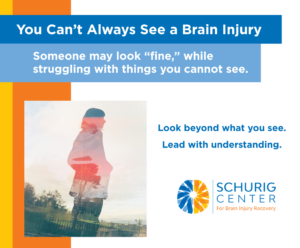
You can't always see a brain injury graphic with photo of person standing

One of the hardest parts of brain injury may be what no one else can see.

After a brain injury, what has become harder may not be visible to others. A person can look fine while struggling with memory, attention, communication, emotions, fatigue, or planning. Everyday tasks and conversations may suddenly require much more effort than they once did.

Someone may lose their train of thought, have trouble finding the right word, become overwhelmed by noise or conversation, forget an appointment, or tire quickly. Changes in emotional regulation can also lead to frustration, anxiety, irritability, or feeling overwhelmed more easily.

Because these effects are invisible, they can be misunderstood. What looks like distraction, frustration, or withdrawal may actually be someone working hard to process information or manage the demands of daily life.

For people living with brain injury, understanding from family, friends, coworkers, and the community can make a meaningful difference. Patience and compassion can help someone feel supported rather than judged or alone.

How You Can Help

  • Slow down and give extra time. Let someone finish a thought or respond without rushing them.
  • Keep things simple. One question or instruction at a time can make communication easier.
  • Reduce distractions. A quieter setting may help someone focus and participate.
  • Ask. Rather than assuming what someone needs, ask. Every brain injury is different. Let the person tell you what works for them.
  • Listen. If someone says they are tired or overwhelmed, believe them without judgment.
  • Be patient with changes. Recovery can take time, and progress may not always be easy to see.

Small adjustments can make everyday interactions more comfortable and help someone with a brain injury feel understood and supported.

When more support is needed, Schurig Center is here.

At Schurig Center, survivors and caregivers can find the ongoing support that is often needed after medical treatment ends. Our programs provide practical tools, connection, and continued rehabilitation to help people adjust to life after brain injury and keep moving forward.

Know someone living with the effects of brain injury?

Connect them with Schurig Center to learn about our programs and resources that may be able to help. No doctor’s referral is needed.

(415) 461-6771
info@schurigcenter.org

Want to help make this support possible?

Your donation helps ensure that people affected by brain injury can access the services they need to thrive. Give today and help someone take the next step in recovery.

Filed Under: Community Education, For Family & Caregivers, For Survivors, Rebuilding Life Skills, Uncategorized

September 17, 2026 by Angela

When a Concussion Changes the Little Things

A concussion is a type of traumatic brain injury caused by a blow, bump, or jolt to the head or body that causes the brain to move rapidly inside the skull. It can happen during a fall, car accident, sports injury, or other type of accident. A person does not have to lose consciousness to have a concussion, and the effects are not always immediately obvious.

For some people, symptoms resolve within days or weeks. For others, concussion recovery can take much longer. Memory problems, difficulty concentrating, fatigue, headaches, changes in communication, sleep, balance, or mood can make everyday life unexpectedly difficult.

Sometimes it isn’t the big things that are most difficult to lose. It is the little, everyday moments that once happened without much thought: reading a few pages of a book without losing your place, walking into a room and remembering why you went there, following a conversation when several people are talking, or getting through a full workday without feeling completely drained.

When “Simple” Things Aren’t So Simple Anymore

One of the hardest parts of life after a concussion can be realizing that things that once felt automatic now require effort. Concentrating on a conversation, remembering an appointment, reading a few pages, or getting through a busy workday may take more energy than it used to. Even familiar environments can become difficult when noise, light, or too much activity becomes overwhelming.

These changes can affect much more than a person’s ability to get through the day.

Someone who was once active and independent may begin turning down invitations, struggling at work, or relying on family members for things they previously handled on their own. Because these challenges are often invisible, survivors may also feel misunderstood when others assume they are fully recovered because they look fine.

Recovery can involve more than waiting for symptoms to disappear. It may mean learning new strategies to manage memory, attention, organization, communication, or energy. Cognitive rehabilitation and speech therapy can help with some of these challenges, while connecting with others who understand brain injury can help survivors regain confidence and feel less alone.

Recovery also does not always follow a straight path. Someone may feel better for a period of time and then have a difficult day, or make progress in one area while continuing to struggle in another. Returning to work, exercise, driving, or social activities may take longer than expected.

A concussion may be considered a mild traumatic brain injury, but its effects are not necessarily mild. Understanding these challenges and recognizing that recovery takes time can make a meaningful difference for survivors and the people around them.

You Are Not Alone After Concussion.
Schurig Center Is Here To Help.

If you or a loved one is experiencing ongoing challenges after a concussion, Schurig Center can help you find a way forward. Located in Larkspur, California, Schurig Center provides non-medical rehabilitation, support, and community for adults and families living with brain injury. Contact us today to talk with our team about your needs, learn which services may be a good fit, and take the next step in your recovery. A doctor’s referral is not needed.

(415) 461-6771
info@schurigcenter.org

Your Generosity Keeps the Door Open for Someone’s Recovery After Concussion

Donations help Schurig Center keep services available to survivors and families as they continue their recovery journey after a concussion, including people who need financial assistance to participate. Your donation can help make sure that when someone is ready to take the next step after a concussion, there is a place to take it.

Filed Under: Concussion, For Family & Caregivers, For Survivors, Rebuilding Life Skills

  • 1
  • 2
  • 3
  • …
  • 22
  • Next Page »

Recent Posts

  • Navigating the Holidays After Brain Injury: Tips for Survivors and Caregivers
  • When Brain Injury Isn’t Visible
  • When a Concussion Changes the Little Things
  • Aneurysm Recovery Continues After the Emergency

Categories


facebook icon   youtube icon   linkedin icon
twitter icon   instagram icon

Schurig Center is a nonprofit 501(c)(3) charitable organization and donations are tax deductible as allowed by law.

Tax ID #68-0105213
Legal Name: Marin Brain Injury Network

PRIVACY NOTICE

  • ABOUT US
    • Mission & History
    • Survivor Stories
    • Our Impact
    • Board of Directors & Advisory Board
    • Meet Our Team
    • Jobs
    • Videos
    • Media
    • Blog
    • Our Garden
    • What is a brain Injury?
  • Planned Giving
  • A Marin County Charity for Brain Injury Recovery
  • Marcia’s Story: Life After a Brain Aneurysm

Schurig Center logo

1132 Magnolia Avenue
Larkspur, CA 94939
(415) 461-6771
info@schurigcenter.org

facebook icon  youtube icon  linkedin icon  x icon  instagram icon

  • OUR SERVICES
    • Services Overview
    • Brain Injury Information Handbook
    • Information & Resources
    • Classes
    • Support Groups
    • Art Therapy
    • Concussion Education
    • Educational Services
    • Caregiver Speaker Series


candid 2026 Platinum Seal of Transparency graphic

  • FOR HEALTHCARE PROFESSIONALS
  • HOW YOU CAN HELP
  • GALA
  • EVENTS
  • CONTACT US

© 2026; Schurig Center for Brain Injury Recovery