Schurig Center for Brain Injury Recovery

Donate Button

Your Generosity Helps Ensure No One Has to Face Brain Injury Alone

  • About
    • Mission & History
    • Survivor Stories
    • Our Impact
    • Board of Directors & Advisory Board
    • Meet Our Team
    • Jobs
    • Videos
    • Media
    • Blog
    • Our Garden
    • What is a brain Injury?
  • Services
    • Services Overview
    • Brain Injury Information Handbook
    • Information & Resource Referral Assistance
    • Classes
    • Support Groups
    • Art Therapy
    • Concussion Education
    • Educational Services
    • Caregiver Speaker Series
  • For Healthcare Professionals
  • Ways You Can Help
  • Gala
  • Events
  • Contact

September 30, 2026 by Angela

When Brain Injury Isn’t Visible

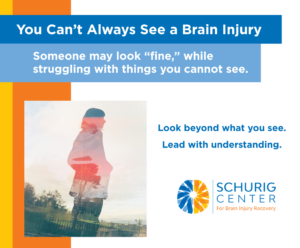
You can't always see a brain injury graphic with photo of person standing

One of the hardest parts of brain injury may be what no one else can see.

After a brain injury, what has become harder may not be visible to others. A person can look fine while struggling with memory, attention, communication, emotions, fatigue, or planning. Everyday tasks and conversations may suddenly require much more effort than they once did.

Someone may lose their train of thought, have trouble finding the right word, become overwhelmed by noise or conversation, forget an appointment, or tire quickly. Changes in emotional regulation can also lead to frustration, anxiety, irritability, or feeling overwhelmed more easily.

Because these effects are invisible, they can be misunderstood. What looks like distraction, frustration, or withdrawal may actually be someone working hard to process information or manage the demands of daily life.

For people living with brain injury, understanding from family, friends, coworkers, and the community can make a meaningful difference. Patience and compassion can help someone feel supported rather than judged or alone.

How You Can Help

  • Slow down and give extra time. Let someone finish a thought or respond without rushing them.
  • Keep things simple. One question or instruction at a time can make communication easier.
  • Reduce distractions. A quieter setting may help someone focus and participate.
  • Ask. Rather than assuming what someone needs, ask. Every brain injury is different. Let the person tell you what works for them.
  • Listen. If someone says they are tired or overwhelmed, believe them without judgment.
  • Be patient with changes. Recovery can take time, and progress may not always be easy to see.

Small adjustments can make everyday interactions more comfortable and help someone with a brain injury feel understood and supported.

When more support is needed, Schurig Center is here.

At Schurig Center, survivors and caregivers can find the ongoing support that is often needed after medical treatment ends. Our programs provide practical tools, connection, and continued rehabilitation to help people adjust to life after brain injury and keep moving forward.

Know someone living with the effects of brain injury?

Connect them with Schurig Center to learn about our programs and resources that may be able to help. No doctor’s referral is needed.

(415) 461-6771
info@schurigcenter.org

Want to help make this support possible?

Your donation helps ensure that people affected by brain injury can access the services they need to thrive. Give today and help someone take the next step in recovery.

Filed Under: Community Education, For Family & Caregivers, For Survivors, Rebuilding Life Skills, Uncategorized

October 8, 2024 by Angela

Inside/Out: Unmasking the Inner Journey of Brain Injury Survivors

The Karen G. Schurig Art Studio is pleased to present The Inside/Out Project

Brain injury is often referred to as an “invisible disability.” On the outside, a person with brain injury may “look fine” to others. But, in reality, the person affected by brain injury may be experiencing a range of cognitive, physical, behavioral, and emotional challenges. Through the creation of hand painted masks, The Inside/Out Project offers brain injury survivors the opportunity to explore and express how they feel others see them on the outside and how they see themselves on the inside. Below is a video featuring masks created by survivors for this project.

Building understanding with a person living with an invisible disability, like a brain injury, requires patience, empathy, and active listening. It’s important to recognize that their challenges may not always be visible, so offering support without making assumptions is key. Open communication and creating a safe space for them to express their needs can foster deeper connection and trust.

The Inside/Out Project Mask Slideshow

Donate Today!

Your generosity powers life-enhancing programs at Schurig Center, like Art Therapy, that help people thrive after brain injury. Thank you!

Filed Under: A Day at the Center, Art & Music, Art Shows, Blog, For Survivors, Therapeutic Art, Uncategorized Tagged With: art therapy, brain injury, concussion, recovery, stroke, tbi

October 21, 2020 by Angela

Your Generosity Ensures No One is Alone

rainbow heart inside heart outlineAs I reflect on Schurig Center’s 35 years, I am inspired and energized by the healing power of a caring community. I hope this note will also lift your spirits by reminding you of the good that you personally help make possible even in these toughest of times. Because of you, no one is alone.

“I’d be terrible.” That’s how John, a stroke survivor, described what life would be like for him without you.

John has severe aphasia, a paralyzed arm, and is unable to read and write. He also lives alone and is confined to his apartment during shelter-in-place. But, happily, John is able to stay connected and continue his recovery in Schurig Center’s speech group, computer class, and art therapy, which are now offered remotely and are powered by your generosity. In the words of his sister, Augusta, these services you help provide are “lifesaving” for John and a “huge relief” for his family.

Together, we’re helping more people.

Despite the pandemic, people are still getting brain injuries. We are still receiving new calls for help. And, the costs to provide services has not changed. Remote services have enabled people outside the Bay Area to attend our programs, and we’ve added a second survivor support group. Over 455 people this past year have been helped by our array of services. While we are serving more people than ever before, 70% of our clients live on a low income and rely on scholarships funded by community members, like you, to access care.

There is much need right now, and I know you are likely receiving many asks. But, if you are in a position to help, I hope you will donate to Schurig Center today as you make your holiday charitable gifts and give as generously as you can.

Your gift by December 31 helps ensure that your fellow community members living with a brain injury stay healthy, connected, and knowing they are not alone. Thank you!

With gratitude,
Patricia Gill, MS
Executive Director

Filed Under: Thank You Community Supporters, Uncategorized, Ways You Can Help Tagged With: art therapy, brain injury, caregiver, charity, concussion, covid response, do good, donate, fundraiser, give, help, holiday giving, Marin, rehabilitation, San Francisco Bay Area, speech therapy, stroke, survivor

  • 1
  • 2
  • 3
  • Next Page »

Recent Posts

  • Navigating the Holidays After Brain Injury: Tips for Survivors and Caregivers
  • When Brain Injury Isn’t Visible
  • When a Concussion Changes the Little Things
  • Aneurysm Recovery Continues After the Emergency

Categories


facebook icon   youtube icon   linkedin icon
twitter icon   instagram icon

Schurig Center is a nonprofit 501(c)(3) charitable organization and donations are tax deductible as allowed by law.

Tax ID #68-0105213
Legal Name: Marin Brain Injury Network

PRIVACY NOTICE

  • ABOUT US
    • Mission & History
    • Survivor Stories
    • Our Impact
    • Board of Directors & Advisory Board
    • Meet Our Team
    • Jobs
    • Videos
    • Media
    • Blog
    • Our Garden
    • What is a brain Injury?
  • Planned Giving
  • A Marin County Charity for Brain Injury Recovery
  • Marcia’s Story: Life After a Brain Aneurysm

Schurig Center logo

1132 Magnolia Avenue
Larkspur, CA 94939
(415) 461-6771
info@schurigcenter.org

facebook icon  youtube icon  linkedin icon  x icon  instagram icon

  • OUR SERVICES
    • Services Overview
    • Brain Injury Information Handbook
    • Information & Resources
    • Classes
    • Support Groups
    • Art Therapy
    • Concussion Education
    • Educational Services
    • Caregiver Speaker Series


candid 2026 Platinum Seal of Transparency graphic

  • FOR HEALTHCARE PROFESSIONALS
  • HOW YOU CAN HELP
  • GALA
  • EVENTS
  • CONTACT US

© 2026; Schurig Center for Brain Injury Recovery