Schurig Center for Brain Injury Recovery

Donate Button

Your Generosity Helps Ensure No One Has to Face Brain Injury Alone

  • About
    • Mission & History
    • Survivor Stories
    • Our Impact
    • Board of Directors & Advisory Board
    • Meet Our Team
    • Jobs
    • Videos
    • Media
    • Blog
    • Our Garden
    • What is a brain Injury?
  • Services
    • Services Overview
    • Brain Injury Information Handbook
    • Information & Resource Referral Assistance
    • Classes
    • Support Groups
    • Art Therapy
    • Concussion Education
    • Educational Services
    • Caregiver Speaker Series
  • For Healthcare Professionals
  • Ways You Can Help
  • Gala
  • Events
  • Contact

May 24, 2019 by Angela

Celebrate Summer Safely

ummer is almost here! School will be out soon and people everywhere will be enjoying vacations and outdoor recreation. Summer is also known as “trauma season” in the healthcare world due to the number of injuries that can happen during summertime activities. While this is true, there are easy things we can do to help reduce the risk of brain injury.

Here are just a few quick tips to help keep your loved ones safe while you enjoy some fun in the summer sun!

Wear a helmet.

Wear a properly fitted helmet when bicycling or engaging in any recreational activity that may result in a head injury. Although there is no “concussion-proof” helmet, a helmet is a must to help reduce the risk of a serious brain injury. After an accident, replace your helmet because it may not be as protective as it was prior to the accident. Visit the CDC’s web site for more helmet safety tips here.

Wear water safety gear and master water safety.

Whether in a pool or the ocean, wearing the appropriate water safety gear, like a life jacket, is critical to preventing injury. Make sure safety gear is well-fitted, worn correctly, and well-maintained. Always supervise children when in or around water. To reduce fall risk, discourage running near or around pools where the ground might be slippery with water. Teach kids to swim. Formal lessons can protect young children from drowning. Learn cardiopulmonary resuscitation (CPR). Your skills could save someone’s life! Get more “H2O Smart” Tips on the CDC’s web site here.

Ensure your home and backyard are safe.

Falls are a leading cause of concussion for both the young and the elderly. To reduce the risk of falls, ensure your home is well-lit and free of tripping hazards, such as electrical cords across walkways, loose rugs, or scattered toys. Consider blocking off stairways with safety gates and installing window guards. Check that outside play equipment is appropriate to the age of the children using it and that it has guardrails to prevent falls as well a soft material underneath, such as mulch or sand.

Be safe behind the wheel.

When you head out on your summer road trip, buckle up with a seatbelt and use age- and size-appropriate car seats that are properly installed for child passengers. The research is clear – belted passengers sustain fewer and less severe traumatic brain injuries compared to those who are unbelted. Find more child passenger safety here.

Be familiar with your surroundings.

When doing outdoor activities, like hiking, or engaging in any high risk sports or motor activities, make sure you are aware of the terrain you are about to encounter as well as your ability to navigate the terrain. Know the depth of water prior to diving into a pool or natural body of water. Always ensure a loved one knows exactly where you are and how to find you. Concussion can occur quickly and cause disorientation that can make it difficult to let others know you are in need of help.

Know the signs of a concussion and get treatment early.
ConcussionSmart Marin LogoA concussion is a type of traumatic brain injury (TBI) caused by a bump, blow, or jolt to the head or by a hit to the body that causes the head and brain to move rapidly back and forth. Signs and symptoms generally show up soon after the injury. However, unlike a broken leg, the signs of a concussion are often ‘invisible,’ such as a headache, disorientation, nausea, incoordination, and memory deficits.

Learn more about the symptoms at ConcussionSmartMarin.org so you can recognize them quickly.
Filed Under: Blog, Community Education, Concussion Tagged With: brain health, brain injury, concussion, concussion education, helmet safety, Marin, prevention, San Francisco Bay Area, Schurig Center for Brain Injury Recovery, summer safety, tbi, traumatic brain injury

June 11, 2018 by Angela

Let’s Talk About Aphasia

June is National Aphasia Awareness Month

According to the National Aphasia Association, aphasia is an acquired communication disorder that impairs a person’s ability to process language, but does not affect intelligence. Aphasia impairs the ability to speak and understand others, and most people with aphasia experience difficulty reading and writing.

Aphasia affects about two million Americans. The most common cause of aphasia is stroke. About 25-40% of stroke survivors acquire aphasia. However, any type of head injury or other neurological causes can cause aphasia.

There are many types of aphasia. Some people have difficulty speaking while others may struggle to follow a conversation. In some people, aphasia is fairly mild and you might not notice it right away. In other cases, it can be very severe, affecting speaking, writing, reading, and listening. While specific symptoms can vary greatly, what all people with aphasia have in common are difficulties in communicating.

Communicating with People Affected by Aphasia

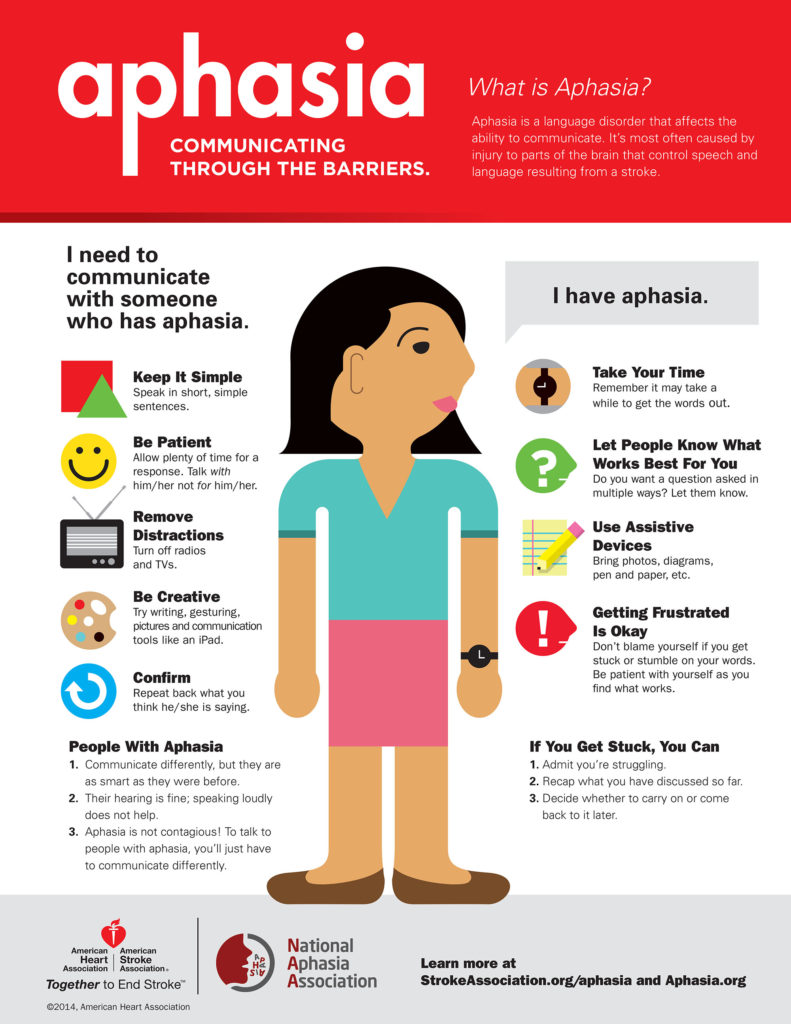
Below are a few helpful tips on how to communicate with a person who has aphasia. To download a free copy of the “Communicating Through the Barriers” poster below, visit the National Aphasia Associations website here.

aphasia communication infographic

Improve Your Communications Skills at Schurig Center

If you or a loved one is experiencing aphasia after a stroke or other neurological impairment, there is a place to go to improve your communication skills! We are pleased to offer a 10-week Aphasia Communication Group. Taught by a license speech therapist, this class provides the opportunity to practice and develop communication and cognitive skills in a supportive environment. Topics covered include: engaging in conversation, body language, communication strategies, listening skills, connections with friends, family, and your community. To get more info about this group, please visit our classes page here.

Filed Under: Blog, Classes, Community Education, Rebuilding Life Skills, Stroke Tagged With: aphasia, communication, Schurig Center for Brain Injury Recovery, stroke

April 20, 2018 by Angela

ConcussionSmart Marin Helps Address Inconsistent Response to Student Concussions in Marin

ConcussionSmart Marin logo[Download press release here]

ConcussionSmart Marin is a community coalition committed to the health of Marin’s youth. Recent reporting by the Marin Grand Jury and the Marin IJ’s editorial voiced concern about Marin’s student concussion response. The coalition ConcussionSmart Marin (‘CSM’) was formed in response to the Grand Jury’s report in 2016 and has been working to address the recommendations of the grand jury’s report since that time. CSM has developed a program for middle school and high school students based on best-practice in other states and from existing models found in California. The program began roll-out to the schools in March during Brain Injury Awareness Month. The goals of CSM are to: 1) Establish a standard level of care in the assessment and treatment of concussion/mild traumatic brain injury; 2) To help in the prevention and awareness of student concussion; and, 3) Ensure schools and student athletic organizations are in compliance with current law.
[Read more…]

Filed Under: Blog, Community Education, Community Partnerships, Concussion, Press Releases Tagged With: concussion, ConcussionSmart Marin, Kaiser Permanente, Marin, Marin Athletic Foundation, Marin County Office of Education, Marin General Hospital, Marin School Nurses Organization, prevention, Schurig Center for Brain Injury Recovery, Sutter Health Novato Community Hospital, youth athletes

  • « Previous Page
  • 1
  • 2
  • 3
  • Next Page »

Recent Posts

  • Navigating the Holidays After Brain Injury: Tips for Survivors and Caregivers
  • When Brain Injury Isn’t Visible
  • When a Concussion Changes the Little Things
  • Aneurysm Recovery Continues After the Emergency

Categories


facebook icon   youtube icon   linkedin icon
twitter icon   instagram icon

Schurig Center is a nonprofit 501(c)(3) charitable organization and donations are tax deductible as allowed by law.

Tax ID #68-0105213
Legal Name: Marin Brain Injury Network

PRIVACY NOTICE

  • ABOUT US
    • Mission & History
    • Survivor Stories
    • Our Impact
    • Board of Directors & Advisory Board
    • Meet Our Team
    • Jobs
    • Videos
    • Media
    • Blog
    • Our Garden
    • What is a brain Injury?
  • Planned Giving
  • A Marin County Charity for Brain Injury Recovery
  • Marcia’s Story: Life After a Brain Aneurysm

Schurig Center logo

1132 Magnolia Avenue
Larkspur, CA 94939
(415) 461-6771
info@schurigcenter.org

facebook icon  youtube icon  linkedin icon  x icon  instagram icon

  • OUR SERVICES
    • Services Overview
    • Brain Injury Information Handbook
    • Information & Resources
    • Classes
    • Support Groups
    • Art Therapy
    • Concussion Education
    • Educational Services
    • Caregiver Speaker Series


candid 2026 Platinum Seal of Transparency graphic

  • FOR HEALTHCARE PROFESSIONALS
  • HOW YOU CAN HELP
  • GALA
  • EVENTS
  • CONTACT US

© 2026; Schurig Center for Brain Injury Recovery