Schurig Center for Brain Injury Recovery

Donate Button

Your Generosity Helps Ensure No One Has to Face Brain Injury Alone

  • About
    • Mission & History
    • Survivor Stories
    • Our Impact
    • Board of Directors & Advisory Board
    • Meet Our Team
    • Jobs
    • Videos
    • Media
    • Blog
    • Our Garden
    • What is a brain Injury?
  • Services
    • Services Overview
    • Brain Injury Information Handbook
    • Information & Resource Referral Assistance
    • Classes
    • Support Groups
    • Art Therapy
    • Concussion Education
    • Educational Services
    • Caregiver Speaker Series
  • For Healthcare Professionals
  • Ways You Can Help
  • Gala
  • Events
  • Contact

July 10, 2019 by Angela

Connecting with Furry Friends that Help People See the World

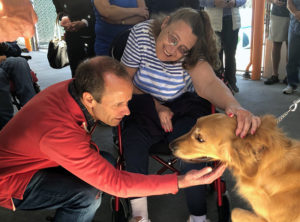
photo of participants petting dogSchurig Center’s latest Community Integration group outing happened in May with a visit to Guide Dogs for the Blind, a leading guide dog school serving people who are blind or visually impaired.

The Guide Dogs team warmly welcomed a group of Schurig Center participants, volunteers, and staff for a walking tour of the San Rafael campus to learn all about their guide dog programs, from birth and puppy socialization to training and pairing with prospective clients.

After the tour, the Schurig group wrapped up the day with lunch and an extra special art project to reflect on what they had learned during the visit – each person created and shared an original art piece depicting their very own dream guide dog.
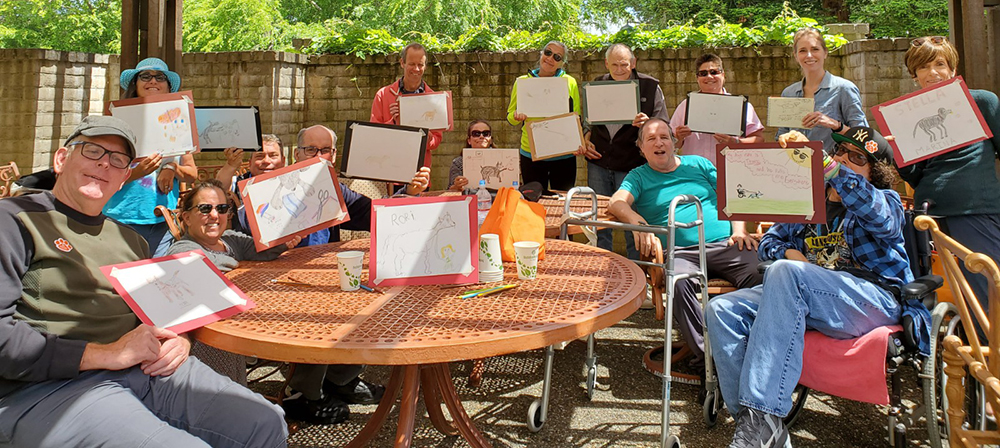
group photo of art project participants

Community Integration… Why It Matters

Community integration outings like this one are important to the recovery process of our participants. Isolation is often one of the greatest challenges facing people living with the effects of a brain injury. These group outings help keep people active and connected by providing an opportunity for participants to:

  • Re-engage with the community
  • Build confidence through personal interactions with new people
  • Practice communication and social skills
  • Support one another through cooperation and peer-to-peer support
  • Increase their sense of independence
  • Participate and not just be an observer
  • Access experiences and activities that may not otherwise be available to them
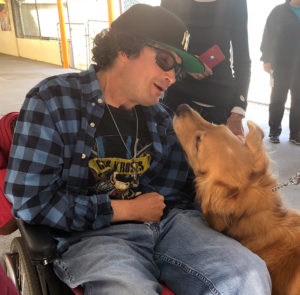
participant with dogThe outings are also a wonderful way for members of the community-at-large to learn more about brain injury as well as to meet and get to know people living with the effects of a brain injury as unique, valuable individuals, not just as their disability.

Our community is truly stronger when everyone is included!

Thank you!

Big thanks to Keith Rosenthal and the rest of the awesome team at Guide Dogs for their time and enthusiasm to make this memorable “warm and fuzzy” day possible for Schurig’s group.

No one should have to go through brain injury alone.
Your generosity helps ensure no one does.

Schurig Center’s innovative programs are powered by the giving of foundations and individual donors, like you. We hope you’ll join us in making critically-needed services, like the Community Integration Program, possible by donating today. Your gift ensures everyone in our community has the opportunity to live happily, meaningfully, and fully. Thank you!

donate now button

Filed Under: A Day at the Center, Community Integration, Community Partnerships, Rebuilding Life Skills Tagged With: brain injury recovery, community integration, concussion, guide dogs for the blind, Marin, Schurig Center for Brain Injury Recovery, stroke

May 24, 2019 by Angela

Celebrate Summer Safely

ummer is almost here! School will be out soon and people everywhere will be enjoying vacations and outdoor recreation. Summer is also known as “trauma season” in the healthcare world due to the number of injuries that can happen during summertime activities. While this is true, there are easy things we can do to help reduce the risk of brain injury.

Here are just a few quick tips to help keep your loved ones safe while you enjoy some fun in the summer sun!

Wear a helmet.

Wear a properly fitted helmet when bicycling or engaging in any recreational activity that may result in a head injury. Although there is no “concussion-proof” helmet, a helmet is a must to help reduce the risk of a serious brain injury. After an accident, replace your helmet because it may not be as protective as it was prior to the accident. Visit the CDC’s web site for more helmet safety tips here.

Wear water safety gear and master water safety.

Whether in a pool or the ocean, wearing the appropriate water safety gear, like a life jacket, is critical to preventing injury. Make sure safety gear is well-fitted, worn correctly, and well-maintained. Always supervise children when in or around water. To reduce fall risk, discourage running near or around pools where the ground might be slippery with water. Teach kids to swim. Formal lessons can protect young children from drowning. Learn cardiopulmonary resuscitation (CPR). Your skills could save someone’s life! Get more “H2O Smart” Tips on the CDC’s web site here.

Ensure your home and backyard are safe.

Falls are a leading cause of concussion for both the young and the elderly. To reduce the risk of falls, ensure your home is well-lit and free of tripping hazards, such as electrical cords across walkways, loose rugs, or scattered toys. Consider blocking off stairways with safety gates and installing window guards. Check that outside play equipment is appropriate to the age of the children using it and that it has guardrails to prevent falls as well a soft material underneath, such as mulch or sand.

Be safe behind the wheel.

When you head out on your summer road trip, buckle up with a seatbelt and use age- and size-appropriate car seats that are properly installed for child passengers. The research is clear – belted passengers sustain fewer and less severe traumatic brain injuries compared to those who are unbelted. Find more child passenger safety here.

Be familiar with your surroundings.

When doing outdoor activities, like hiking, or engaging in any high risk sports or motor activities, make sure you are aware of the terrain you are about to encounter as well as your ability to navigate the terrain. Know the depth of water prior to diving into a pool or natural body of water. Always ensure a loved one knows exactly where you are and how to find you. Concussion can occur quickly and cause disorientation that can make it difficult to let others know you are in need of help.

Know the signs of a concussion and get treatment early.

ConcussionSmart Marin LogoA concussion is a type of traumatic brain injury (TBI) caused by a bump, blow, or jolt to the head or by a hit to the body that causes the head and brain to move rapidly back and forth. Signs and symptoms generally show up soon after the injury. However, unlike a broken leg, the signs of a concussion are often ‘invisible,’ such as a headache, disorientation, nausea, incoordination, and memory deficits.


Learn more about the symptoms at ConcussionSmartMarin.org so you can recognize them quickly.

Filed Under: Blog, Community Education, Concussion Tagged With: brain health, brain injury, concussion, concussion education, helmet safety, Marin, prevention, San Francisco Bay Area, Schurig Center for Brain Injury Recovery, summer safety, tbi, traumatic brain injury

December 6, 2018 by Angela

Gift Ideas for Brain Injury Survivors

Here’s are a few gift ideas that might help improve quality of life for your friend or loved one who is living with a brain injury, concussion, or stroke.

  1. Voice memo recorder – A helpful, auditory version of a self-stick note! This easy-to-use, hand-held gadget can be used to record messages to oneself throughout the day. Recorders are great for people who are unable to write due to aphasia or motor problems. They’re also helpful in capturing “on-the-fly” thoughts or to-do items that can be listened to later and transferred to a calendar, planner or to-do list.
  2. Journal or planner – Journals and planners are wonderful gifts to help keep a person organized and on-track with their “to-do” lists. For many survivors, they are an essential tool in managing day-to-day activities, like paying bills and attending appointments. Journals are also meaningful gifts that can help a person express his/her thoughts and emotions as they process the changes in their life after a brain injury.
  3. Subscription to an app – There are many apps available that can help enrich a person’s life after a brain injury. Calm is an app for meditation, restful sleep, mindful movement, and music for focus, relaxation, and sleep. Audible is a great app for an avid reader that may be finding that reading is more difficult after a brain injury.
  4. Scanmarker – A Scanmarker is hand-held digital highlighter and scanner pen that scans words on a paper and wirelessly uploads them to your smartphone, tablet, or computer. Wherever you use your keyboard to type – Scanmarker instantly types it for you. A great gift for a person who is unable to write legibly or type due to aphasia or motor problems.
  5. Post-it notes – A bulk supply of self-stick notes in various sizes and colors (lighter colors are best) are a great stocking stuffer to help a survivor stay organized. Strategically placed around the house, the car, or in a planner, self-stick notes are useful “reminder” tools.
  6. Automatic shut-off appliances – Auto shut-off appliances, like irons or coffee brewers, can truly be a lifesaver for a survivor whose memory may not be as good as it once was.
  7. Subscription to a meal service – Grocery shopping and preparing healthy food can be challenging after a brain injury because a person may not be able to go to the grocery store on their own. These meal services are extra helpful because food arrives portioned into the correct measurements with recipe options. Not having to worry about grocery shopping or measuring foods can really take off a lot of stress off eating healthy.
  8. Prepaid bus pass or Uber/Lyft gift card – Many survivors aren’t able to drive and must rely on public transportation or friends and family to get around town. The gift of transportation is a wonderful way to promote a feeling of independence.
  9. Gym or pool membership – Keeping active and getting ample physical exercise is good for everyone’s health, including brain injury survivors. But, a survivor may not be able to work after their injury and are unable to afford a gym or pool membership. Consider even paying for a trainer to work with the person one-on-one. An exercise, Qi Gong, or yoga DVD is also a great gift.
  10. Noise cancelling headphones – A person can often be triggered by noises after a brain injury. Noise cancelling headphones can help provide relaxation by drowning out loud, triggering noises or promote sleep for people who are very sensitive to noise while sleeping.
  11. Extra-large key chain – A great way to help someone keep track of keys. Some key chains even come with a beeper-finder feature.
  12. Pillow or weighted blanket – Headaches and difficulty sleeping are common side effects that can be experienced after a brain injury. Upgrading to a quality pillow can help reduce headaches. Buy a quality pillow or give a store gift card so the recipient can pick out a pillow of his/her preference. A weighted blanket is pretty much what it sounds like – a heavy blanket. When placed on the body, the weight feels comforting without being restrictive. It is believed to offer many benefits, including improved sleep and anxiety reduction. The weight of the blanket should be specific to the person using it. The general formula for picking a weight is 10% of the user’s body weight plus a pound or two.
  13. Adaptive eating and kitchen utensils – It can sometimes be hard to use traditional utensils to eat or prepare food after a brain injury. There are many different types of adaptive eating and kitchen utensils to help aid in the process, like adaptive silverware, a rocking knife, or snug straw.
  14. Essential oil diffuser – Essential oils are natural aromatic plant compounds that are believed to offer a variety of benefits. Peppermint can help with headaches. Lavender is known for calming and relaxing properties. Frankincense can offer wonderful mood support; help improve focus and concentration, and may reduce irritability and restlessness.
  15. Eye mask or sun blocking curtains – A brain injury survivor may experience periods of insomnia. An eye mask or sun blocking curtains can help a person sleep well during the day.
  16. Jigsaw puzzle – Jigsaw puzzles can be a great therapeutic tool to help rebuild cognitive abilities. Start with a 25-piece puzzle and graduate to larger puzzles as a person’s abilities improve.
  17. Hands-free hair blow dryer holder – After a brain injury, many people don’t have the same coordination in their hands and arms that they once had. A wall-mounted, hands-free blow dryer holder can help make creating the perfect “hair-do” much easier.
  18. Shoe lace anchors – Some survivors may find it challenging to tie shoe laces. Lace anchors are a great stocking stuffer that will help pull laces tight without having to tie.
  19. Watch – After a brain injury, people often find that they lose track of time because their “internal clock” may be off. An easy-to-read watch, showing the time, day and date can be super helpful. Many watches even come with alarm settings and displays to program in phone numbers and appointments. An alarm feature can help survivors learn to take their medications independently or serve as a reminder to cue a person to their next task or appointment.
  20. Give a gift from the heart to help make everyday living easier – Daily living with the effects of a brain injury can be challenging. There are many meaningful and personal gifts you can offer that will help improve a person’s quality of life. Offer to help organize bills or help run errands. Pay a bill. Living with a brain injury can be expensive, especially if a person is unable to work after his/her injury. Offering to pay a bill is a great way to help ease financial burdens. Hire a cleaning service. Prepare and share a home cooked meal. Not sure how you can help? Just ask.

Filed Under: For Family & Caregivers, For Survivors Tagged With: concussion, Gift ideas, holidays, Marin, Schurig Center for Brain Injury Recovery, Sonoma, stroke, survivor, traumatic brain injury

  • « Previous Page
  • 1
  • …
  • 7
  • 8
  • 9
  • 10
  • 11
  • …
  • 22
  • Next Page »

Recent Posts

  • Navigating the Holidays After Brain Injury: Tips for Survivors and Caregivers
  • When Brain Injury Isn’t Visible
  • When a Concussion Changes the Little Things
  • Aneurysm Recovery Continues After the Emergency

Categories


facebook icon   youtube icon   linkedin icon
twitter icon   instagram icon

Schurig Center is a nonprofit 501(c)(3) charitable organization and donations are tax deductible as allowed by law.

Tax ID #68-0105213
Legal Name: Marin Brain Injury Network

PRIVACY NOTICE

  • ABOUT US
    • Mission & History
    • Survivor Stories
    • Our Impact
    • Board of Directors & Advisory Board
    • Meet Our Team
    • Jobs
    • Videos
    • Media
    • Blog
    • Our Garden
    • What is a brain Injury?
  • Planned Giving
  • A Marin County Charity for Brain Injury Recovery
  • Marcia’s Story: Life After a Brain Aneurysm

Schurig Center logo

1132 Magnolia Avenue
Larkspur, CA 94939
(415) 461-6771
info@schurigcenter.org

facebook icon  youtube icon  linkedin icon  x icon  instagram icon

  • OUR SERVICES
    • Services Overview
    • Brain Injury Information Handbook
    • Information & Resources
    • Classes
    • Support Groups
    • Art Therapy
    • Concussion Education
    • Educational Services
    • Caregiver Speaker Series


candid 2026 Platinum Seal of Transparency graphic

  • FOR HEALTHCARE PROFESSIONALS
  • HOW YOU CAN HELP
  • GALA
  • EVENTS
  • CONTACT US

© 2026; Schurig Center for Brain Injury Recovery